The Design Philosophies of GPT, Claude, Gemini, Grok, and DeepSeek





Have you ever asked the same question to multiple AI models? Even with the exact same question, the tone of each response is noticeably different. One model may explain in detail and with warmth, while another declines to answer. Some are blunt and direct; others produce safe, middle-of-the-road responses to almost anything.
Is this a matter of AI model performance or design? Not exactly. GPT, Claude, Gemini, Grok, and DeepSeek all share the same technical foundation: the large language model (LLM). They all train on vast amounts of text data and probabilistically predict the next word, so at that level they are not fundamentally different.
Think of how some cars are designed with safety as the top priority, others emphasize speed and performance, and others prioritize fuel efficiency. AI models work the same way. All start from a similar technical foundation, but what each one was designed to prioritize determines differences in tone, judgment criteria, how much risk they take on, and the threshold for declining a request.
Let us now look at the characteristics and design priorities of the major AI models. In this chapter we will survey each model at a high level; in subsequent chapters we will explore each in greater depth, including their development history.
GPT: A Mass-Market AI Aimed at General-Purpose Use
The GPT model used in ChatGPT is a series developed by US-based OpenAI since 2018. The most important direction OpenAI pursued in designing GPT was a general-purpose model usable in any situation. The goal was not a tool specialized for a single domain, but one capable of producing natural, helpful responses across a wide range of contexts: writing, coding, organizing ideas, answering questions.
This philosophy carried over directly into the training approach. GPT introduced RLHF (Reinforcement Learning from Human Feedback), reinforcement learning that uses human feedback, to train the model to produce responses aligned with human preferences.
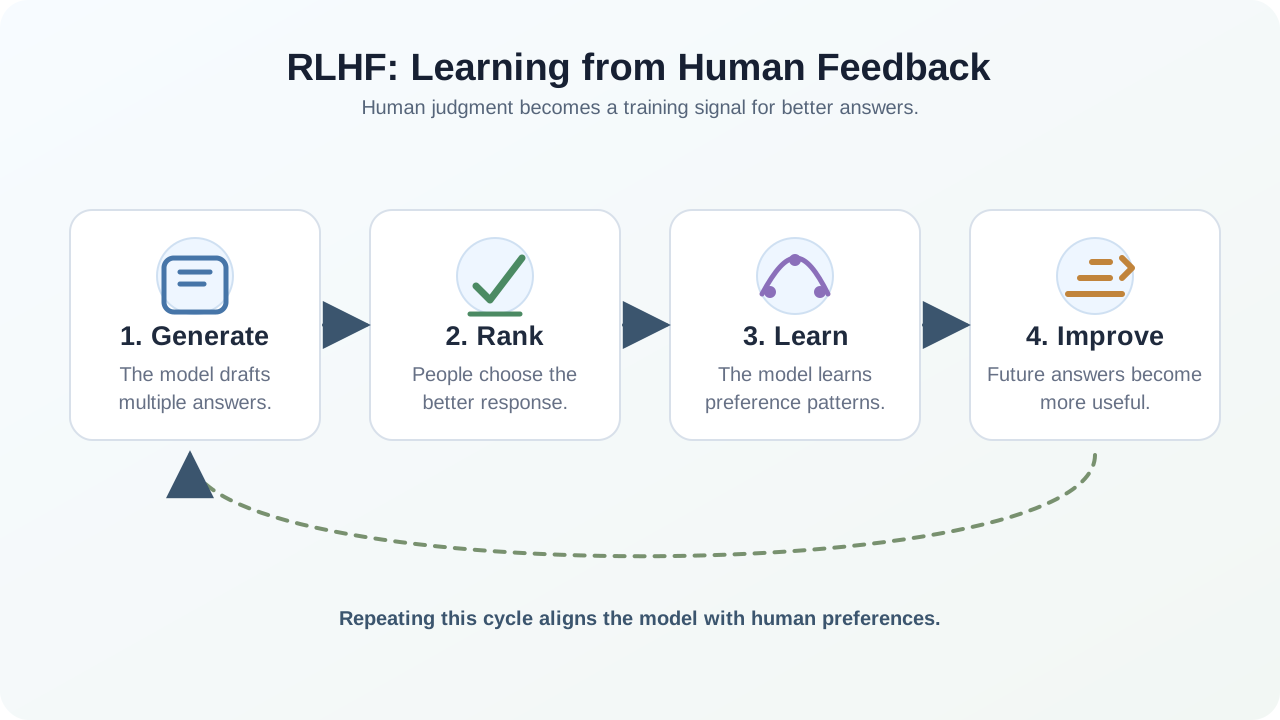
The core of this approach is that humans directly define "what a good response looks like." As a result, GPT excels at producing relatively balanced and practical answers across a wide range of topics.
Another characteristic is an ecosystem-centered strategy. OpenAI has grown not only the model's performance but also the services and developer environment built on top of it. It has released products like GPTs (a platform for providing GPT models specialized for specific industries) and Codex (an AI coding tool for developers), designing GPT to be not a single model but the hub of an AI ecosystem.
Thanks to this general-purpose approach, GPT holds the highest market share as of January 2026 (approximately 70–80%).
Claude: An AI Model Centered on Safety and Principles
Claude is a large language model developed by the US AI startup Anthropic. Anthropic was founded in the United States in 2021 by key former members of OpenAI. Claude was first released in 2023 and has since rapidly expanded into the B2B and AI coding markets while improving performance and reliability.
Anthropic did not set out to build "a smarter model." It started from a conviction that AI needed to be designed as a safe AI model grounded in principles. OpenAI also gave considerable thought to safety and ethics while developing GPT, but Anthropic concentrated on embedding even stricter safety standards and principles directly into the model.
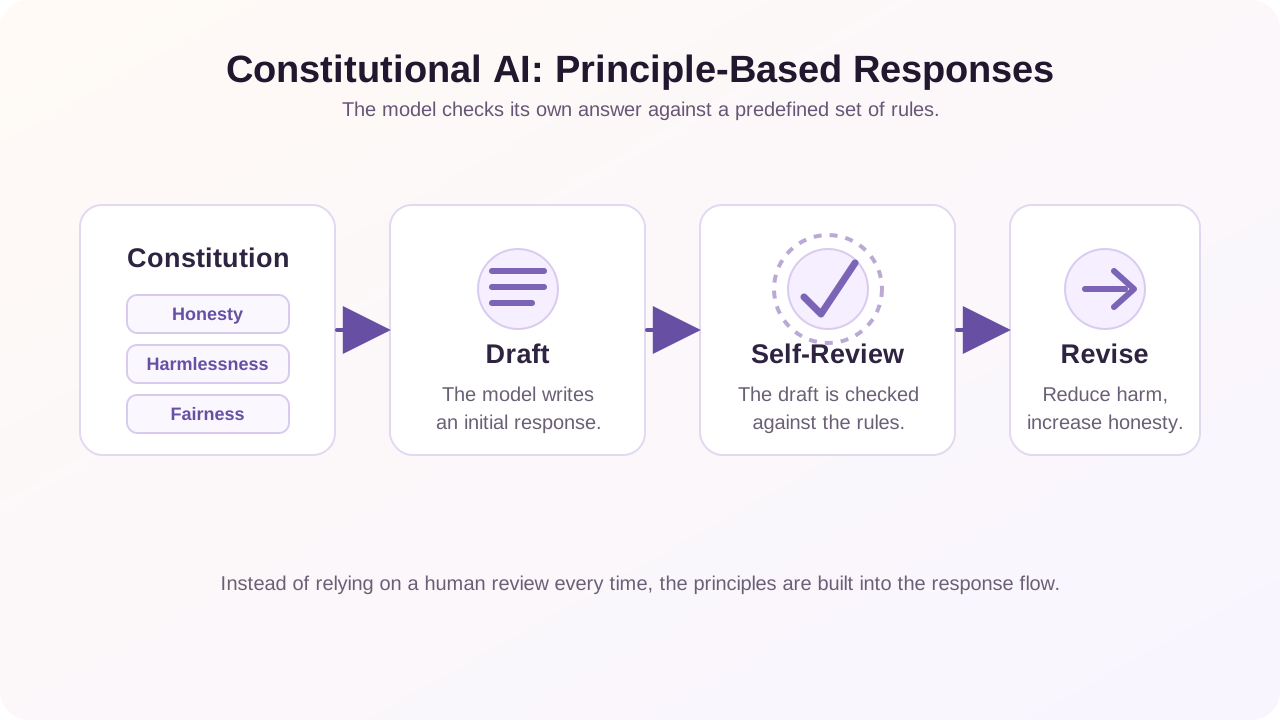
This conviction also shaped the training approach. Anthropic introduced a principle-based training method through the Claude Constitution and Constitutional AI. Rather than having humans evaluate every individual situation, this approach pre-defines the principles the AI must follow and trains the model to review and revise its own responses against those principles.
Just as a constitution serves as a country's foundational norm, Claude is designed to self-check questions against internal standards: "could this response cause harm?", "does it contain discriminatory language?", "is it based on fact?"
As a result, Claude tends to express uncertainty cautiously and places limits on requests that carry risk. This design philosophy makes it strong in coding, summarizing long documents, and policy compliance, and it is perceived among enterprise customers in particular as a "safe conversational AI."
Claude's commitment to safety and control is strong enough that it has caused friction with the US Department of Defense, which makes it a prime example of how AI models can be designed differently.
Gemini: An AI Model Aimed at Processing Diverse Information and Service Integration
Gemini is a large language model developed by US company Google. It was first released in late 2023 and is Google's flagship next-generation model, emerging after its leading research organizations Google Brain and DeepMind merged. Unlike GPT or Claude, which developed primarily around text, Gemini was designed from the start to understand multiple forms of information together.
Behind this is the vast data and service infrastructure Google has accumulated over the years. Google recognized that across a broad information environment spanning Search, YouTube videos, Maps, and voice recognition, a single-form language model alone would not be sufficient. Gemini made it a core direction to process this diverse data in an integrated way within a single model.
This is called multimodal design. Rather than handling text, images, audio, and video separately, the structure was built from the start to understand and connect all of them together. For example, requests like "watch this video and summarize the key points" or "identify the error in the graph in this image" require simultaneous visual processing and linguistic analysis. Gemini focuses on handling these composite tasks naturally.
Another characteristic is deep integration with the Google ecosystem. Gemini is expanding less as an independent chatbot tool and more as something that seamlessly integrates into widely used services like Google Search, Gmail, YouTube, and Android. It is weaving itself into everyday workflows: automatic email summarization, document drafting, spreadsheet data analysis support.
In short, Gemini was designed from the start to understand diverse forms of information together rather than being a text-centered model that later added other capabilities. It is also developing beyond a standalone conversational AI, improving the user experience through seamless integration with existing Google services such as search, documents, email, and mobile.
Grok: A Model That Emphasizes Openness and Real-Time Awareness
Grok is a large language model developed by US company xAI. xAI was founded in 2023 by Elon Musk with the vision of "building AI that understands the true nature of the universe." Grok was released the same year through X (formerly Twitter) and has been updated to new versions relatively quickly.
The starting point of Grok lies in Elon Musk's concerns. He was one of OpenAI's co-founders but later left the company and has publicly criticized OpenAI for becoming excessively commercialized. He also contended that existing AI systems were too focused on political correctness (what he called the "woke mind virus"). xAI, built on this premise, advocates for a more open and direct AI.
Grok's most distinctive feature is tight integration with X, one of the social media platforms that most rapidly reflects global trends and circulates information. Grok is designed to draw on X's real-time data to reflect currently discussed issues and public opinion flows. This differentiates it from traditional large language models that heavily depend on data up to a training cutoff date. As a result, Grok tends to respond more quickly to ongoing events and trends.
Another characteristic is freedom of expression. Grok permits witty phrasing and satirical responses, and takes a relatively permissive approach to adult content and to politically or socially sensitive topics that other models handle with more restrictions. It avoids overly hedged or formulaic answers and aims for a tone closer to human conversation.
In this way, Grok can be seen as a model that places greater weight on freedom of expression and openness than on AI safety and control.
DeepSeek: A Model That Chose Efficiency and Openness
DeepSeek is a large language model developed by an AI research organization established by Chinese quantitative hedge fund High-Flyer. It attracted rapid attention after its public launch from 2023 onward, drawing industry interest with two differentiators: efficiency and open source (software with publicly available code).
DeepSeek achieved this by optimizing its model architecture and training methods in a context where US semiconductor export restrictions made it difficult for Chinese companies to obtain high-performance GPUs. It reduced unnecessary computation and extracted more performance from the same resources. Through this design philosophy of maximizing efficiency, it succeeded in training AI models at far lower cost than US big-tech companies and in significantly reducing inference costs as well.
DeepSeek also chose to publicly release its model weights and technical reports, a stark contrast to large companies like OpenAI and Google, which keep the core technology of their models private.
This design direction contributed to DeepSeek spreading rapidly around the world and establishing itself as a model with particular strengths in coding and logical reasoning.
At the same time, due to internet censorship and information control within China, DeepSeek tends to decline or restrict responses on politically sensitive topics. This shows that pursuing efficiency and openness in design does not necessarily mean complete freedom in every domain.
A Comprehensive Comparison of Major AI Models
Summarizing the design directions of each model covered above:
| Model | Developer | Core Direction | Key Characteristics |
|---|---|---|---|
| GPT | OpenAI | General-purpose | RLHF, ecosystem-centered strategy, ChatGPT/API expansion |
| Claude | Anthropic | Safety & honesty | Constitutional AI, HHH principles |
| Gemini | Google DeepMind | Multimodal integration | Text/image/video integration, Google service integration |
| Grok | xAI | Openness & directness | X real-time data integration, relatively relaxed restrictions |
| DeepSeek | High-Flyer | Efficiency & open strategy | Low-cost high-performance design, public model weights |
These differences between AI models mean that when asked about a sensitive political topic, Claude tends to present multiple perspectives in a balanced and cautious manner, while Grok is more likely to give a direct answer. On medical or legal questions, GPT and Claude often add a note recommending professional consultation, while Grok more readily attempts an immediate explanation.
The "personality" that users perceive in AI is not accidental. It directly reflects what each model was designed to prioritize, expressed in its tone of conversation and its reasoning approach.
Want to learn more?
Join CodeFriends Plus membership or enroll in a course to start your journey.