Google's Counter: The TPU
Competitiveness in the AI era depends not only on "how good a model you can build," but also on how efficiently you can operate it. The latest AI models continuously repeat enormous-scale matrix operations internally. To handle this computation, the world has relied on a device called the GPU (Graphics Processing Unit).
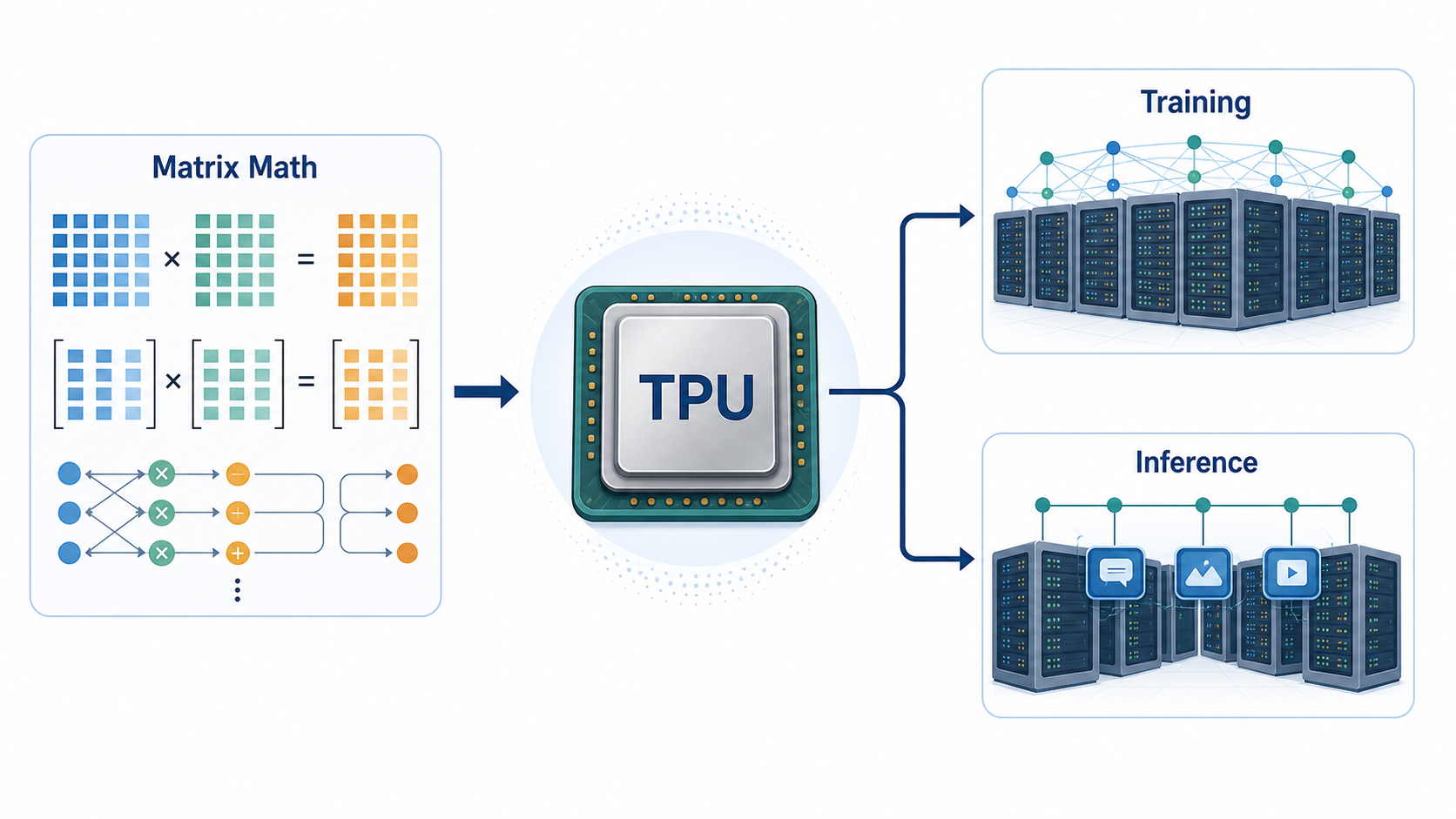
However, Google determined that depending exclusively on GPUs from specific manufacturers like NVIDIA posed a long-term risk. It decided to directly design and control the core processes of AI computation itself. The result is the TPU (Tensor Processing Unit). The TPU is not a general-purpose chip. It is an application-specific integrated circuit (ASIC) designed with a structure optimized for deep learning operations.
Why Did Google Design Its Own Chip?
Google's core services, including Search, Translate, YouTube, and voice recognition, all operate on top of massive deep learning models. For Google, which must handle tens of billions of requests every day, hardware efficiency directly translates to data center operating costs.
-
GPU limitations: GPUs were originally created for graphics processing and later expanded to general-purpose computation. They have the advantage of flexibly handling a wide variety of tasks, but viewed purely from an AI computation perspective, they carry unnecessary features and power consumption.
-
Google's strategy: Google chose to sacrifice some generality and directly design a chip that eliminates unnecessary features and maximizes matrix operation efficiency, dramatically reducing power consumption and operating costs.
For What Purpose Is the TPU Designed?
The Tensor in the TPU's name refers to the "multi-dimensional array," the basic unit through which data flows in deep learning.
- GPU (general-purpose): Equipped with complex control units and cache memory to handle diverse tasks including graphics rendering, engineering computation, and AI.
- TPU (special-purpose): Focuses exclusively on "matrix multiplication," the core of deep learning. Complex control logic is minimized, and that space is densely packed with computation units.
Thanks to this deliberate specialization, the TPU achieves overwhelming "performance per watt," processing more AI computation than a GPU for the same amount of power.
Is the TPU Only Used Internally at Google?
Early TPUs were limited to Google's internal research and services, and to the AI framework called TensorFlow. Today, however, the situation has changed.
- Opened through the cloud (Google Cloud Platform): Anyone can rent TPU resources through Google Cloud Platform. Companies and research institutions around the world are using TPUs to train large language models (LLMs).
- Support for diverse frameworks: Unlike the past, today's TPUs offer full support not only for TensorFlow but also for cutting-edge frameworks most widely used by researchers, such as
PyTorchandJAX.
The cloud refers to services where you rent computing resources over the internet. For example, you can rent TPUs from Google Cloud to train an AI model.
The TPU was originally designed as "a chip specialized for matrix computation," but with software compatibility now secured, it is widely used as a "general-purpose AI accelerator."
Summary Comparison: GPU vs. TPU
| Category | GPU (Graphics Processing Unit) | TPU (Tensor Processing Unit) |
|---|---|---|
| Design purpose | Graphics processing + general-purpose scientific computation | Specialized for deep learning / matrix operations |
| Flexibility | Very high (gaming, rendering, crypto mining, AI, etc.) | Low (focused on AI computation) |
| Strengths | Broad ecosystem, purchasable and usable anywhere | Outstanding power efficiency, easy to configure large clusters |
| Primary use | Personal PCs, workstations, all cloud providers | Google Cloud (GCP), large-scale AI data centers |
The emergence of the TPU signals that competition in the AI industry is no longer just about software development. It has become a comprehensive contest that extends to hardware infrastructure as well. As AI models grow larger and more complex, the importance of AI-specialized hardware like the TPU will only continue to grow.