The Story Behind NVIDIA's Rise and the Concept of CUDA
As the AI industry grows rapidly, one company name keeps appearing. That company is NVIDIA. Once known primarily as a manufacturer of gaming graphics cards, how did it become the core infrastructure company of the AI era? Was it simply because their GPUs were high-performance, or was there something more important at work?
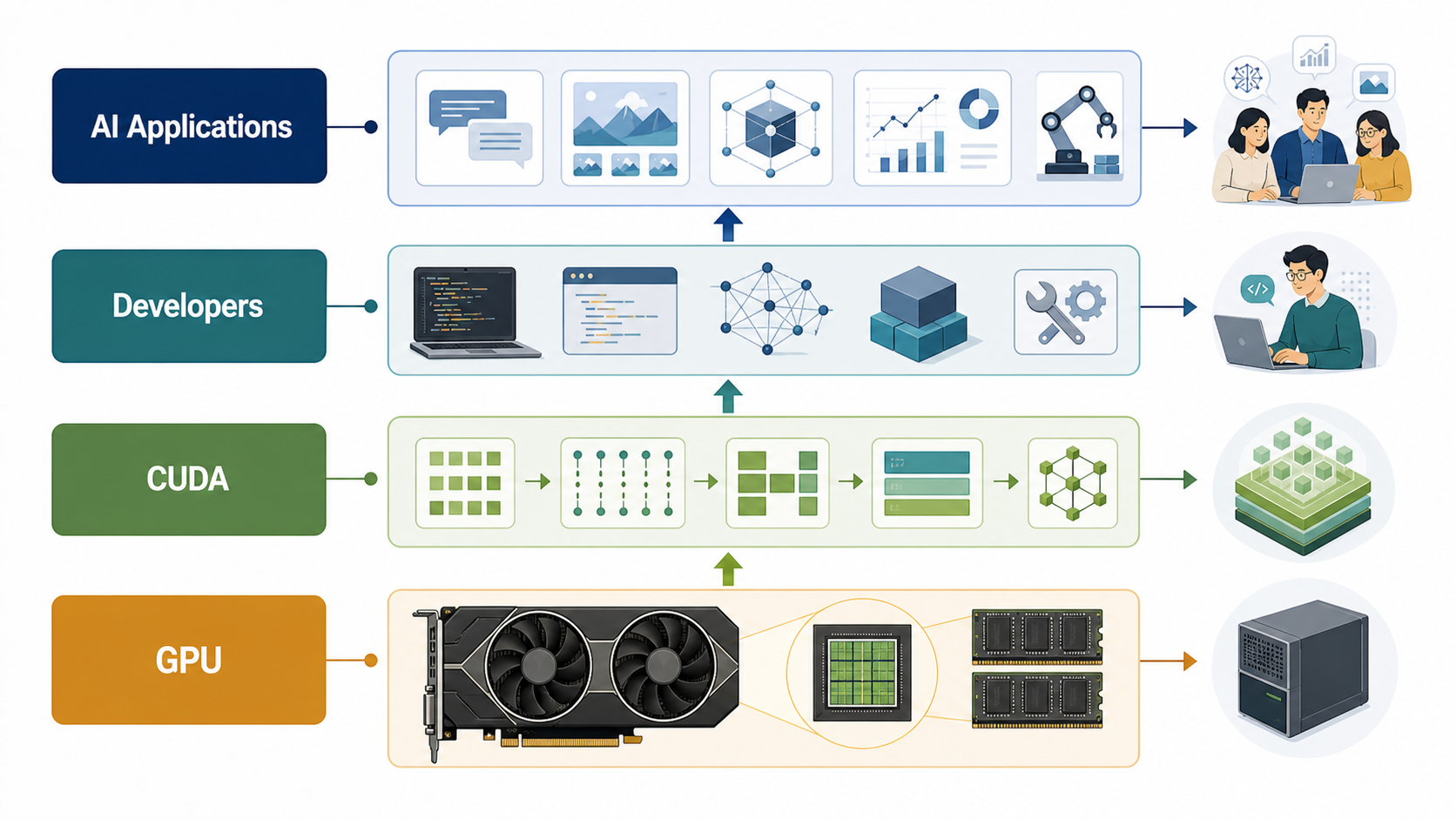
To answer that question, we need to understand both hardware (GPU) and software (CUDA) together.
NVIDIA's History and the Birth of the GPU
NVIDIA was originally a company that designed GPUs (graphics processing units) for 3D gaming. A game screen contains millions of pixels that must be calculated simultaneously to produce smooth visuals. So GPUs were designed from the start with a "process many calculations at the same time" architecture.
This structure later made an unexpected connection with AI. The core operation of deep learning is repeatedly multiplying enormous number tables (matrices). This computation involves an enormous number of small multiplications and additions repeated over and over, making it well suited to parallel processing. In other words, the GPU's architecture was a natural fit for deep learning's computational approach.
The Arrival of CUDA
The fact that GPUs are fast was not alone sufficient to reshape the AI industry around NVIDIA. Early GPUs were close to being graphics-only devices. It was difficult for general developers to easily write programs and run computations on a GPU. The hardware's potential existed, but the environment to take advantage of it was not sufficiently in place.
What lowered this barrier was CUDA.
CUDA is a GPU programming platform created by NVIDIA. Simply put, it is an environment that makes it possible to use GPUs not just as graphics-dedicated devices but as "general-purpose computation devices." Developers could use familiar programming languages to perform large-scale computations on GPUs, and deep learning researchers began using it to train models.
This shift was not simply a technical improvement. It was closer to a change of direction. GPUs were no longer just devices for drawing screens; they had become devices for computing AI.
The Value of CUDA and Its Role in the AI Ecosystem
The value of CUDA does not end at "making GPUs easier to use." CUDA built a software ecosystem that works alongside the GPU.
Libraries for rapidly performing matrix operations on GPUs, tools to assist with large-scale numerical computation, and acceleration technologies specialized for deep learning all developed around CUDA. Major deep learning frameworks (software environments for deep learning development) also adopted CUDA as their default execution environment. When researchers and companies begin development in the same environment, code, knowledge, and infrastructure naturally accumulate on top of that platform.
Already, a large body of code has been written on CUDA, and countless companies have built their systems around it. Moving to a different platform requires code modifications, performance verification, and rebuilding the development environment, all of which carry significant cost. The higher these switching costs, the stronger CUDA's economic moat becomes.
Why Did NVIDIA Become the Center of the AI Era?
As AI models grow larger, the required computation grows exponentially. Training large models requires massive parallel computation, and when large numbers of users simultaneously use a service, significant computational resources are required at the inference stage as well. The majority of this computation depends on GPUs.
The key point is not simply "producing many GPUs," but "providing GPUs optimized for AI computation together with the software environment that runs on top of them." NVIDIA has continuously expanded the CUDA ecosystem while improving hardware performance. As a result, NVIDIA GPUs and CUDA have become the de facto default choice across the AI industry.
NVIDIA's growth was not accidental. It possessed a parallel computation device in the form of the GPU, and through CUDA, which expanded that device into a general-purpose computation platform, it captured the development ecosystem early. A strategy of simultaneously advancing hardware and software aligned precisely with the AI era.
AI operates on top of enormous numerical computation. NVIDIA was the company that built the environment to perform that computation quickly and reliably, first and most systematically. This is why today NVIDIA is not merely a graphics card company, but a company that has come to symbolize AI infrastructure.