AI's Mistake: What Is Hallucination?
AI sometimes generates information that sounds very plausible but is simply not true. It may cite papers that do not exist, describe fictitious individuals as if they were real experts, or state incorrect figures with complete confidence. This phenomenon is called hallucination.
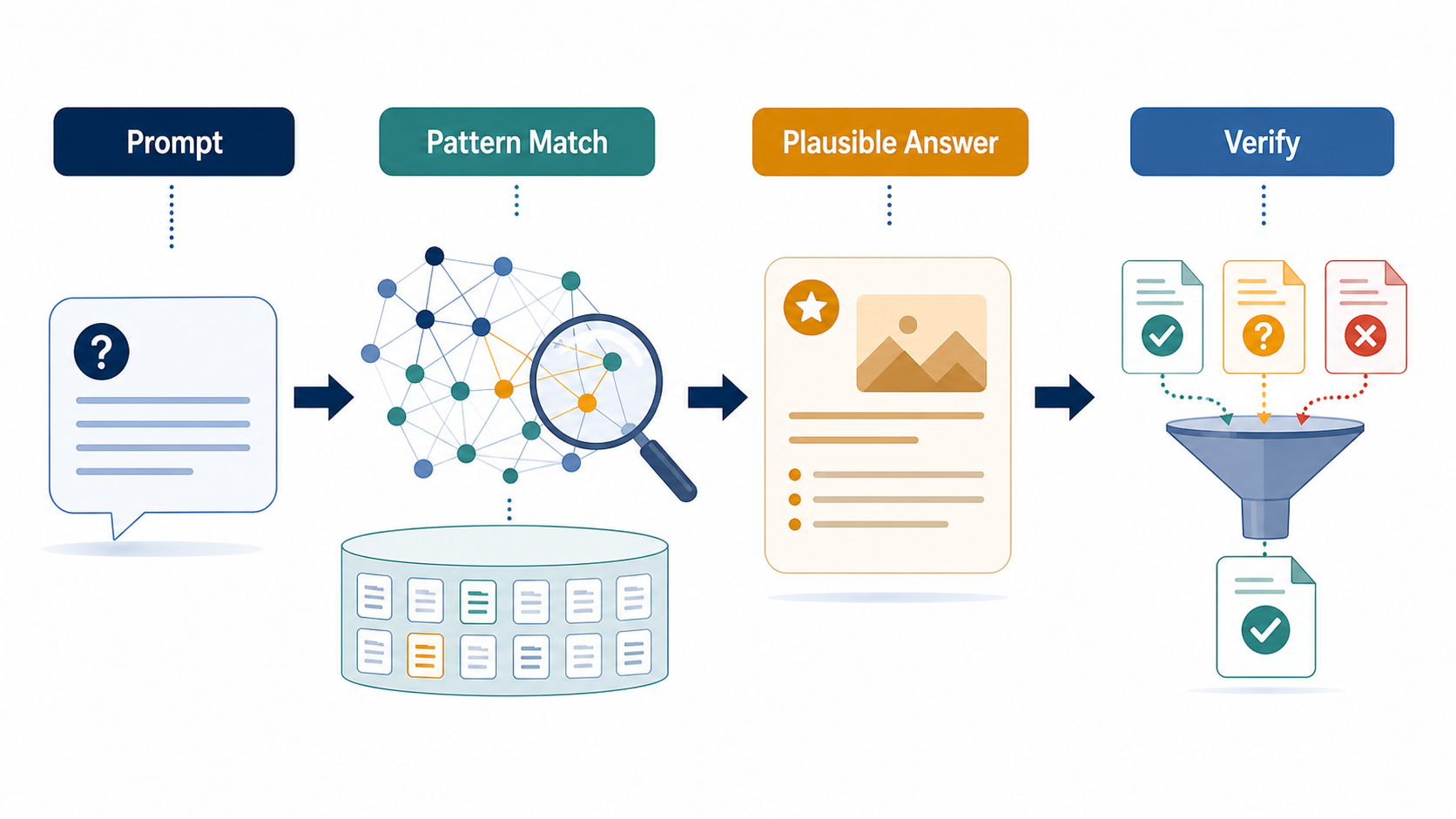
The word originally means "seeing something that does not exist." Hallucination in AI is similar. The model is not reporting the result of verifying facts. It is generating plausible-sounding sentences based on learned patterns.
Why Does Hallucination Occur?
AI is not a system that searches for information and determines whether it is true. Its basic structure is "a model that probabilistically predicts the next token." When given a question, rather than verifying "is this information correct?", it chains an answer together based on "what kinds of sentences appeared frequently in response to this type of question?"
Consider this question as an example:
Summarize the contents of Dr. ○○'s quantum mechanics paper published in 1923.
Even if that paper does not actually exist, the model can produce a sentence that matches the pattern of "quantum mechanics paper summary." It combines academic tone, technical terminology, and date expressions to generate a very natural-sounding sentence. But the content is not the result of consulting any actual source.
The model's goal is not to verify facts. It is to select the most natural next sentence given the current context. This structural characteristic is the root cause of hallucination.
In What Situations Does It Occur Most Often?
The frequency can vary depending on model size and design, but hallucinations are particularly common in the following situations:
- Asking about people or events whose real existence is unclear
- Requiring up-to-date information or real-time data
- Requesting a specific source or precise statistics
- Asking about specific numbers or dates
AI is not a search engine that always queries the latest database. Events after the training cutoff date, or very specific figures, are likely to be inaccurate.
How Can Hallucinations Be Reduced?
They cannot be eliminated entirely, but there are ways to reduce them.
- Write questions specifically. Vague questions cause the model to generate answers from a wide possibility space.
- Request supporting evidence. A request like "please include your sources" increases the likelihood of a more careful answer.
- Cross-check important information. Especially for content related to medicine, law, or finance, separate verification is essential.
- Specify that it should say it does not know when uncertain. A condition like "if you're not sure, just say you don't know" helps reduce reckless guessing.
Hallucination is a phenomenon that arises from the structural nature of AI. A model is not an entity that verifies facts; it is a system that probabilistically generates the next sentence based on learned patterns. Therefore, AI's responses must always be subject to review and verification. To use AI effectively, understanding its limitations must go hand in hand with using it.