What Does AI Learn, and How? The Principles Behind Learning from Data
In the previous chapter, we examined the types of AI and the characteristics of generative AI. A natural question follows: What does AI learn? And how is that learning different from how humans learn?
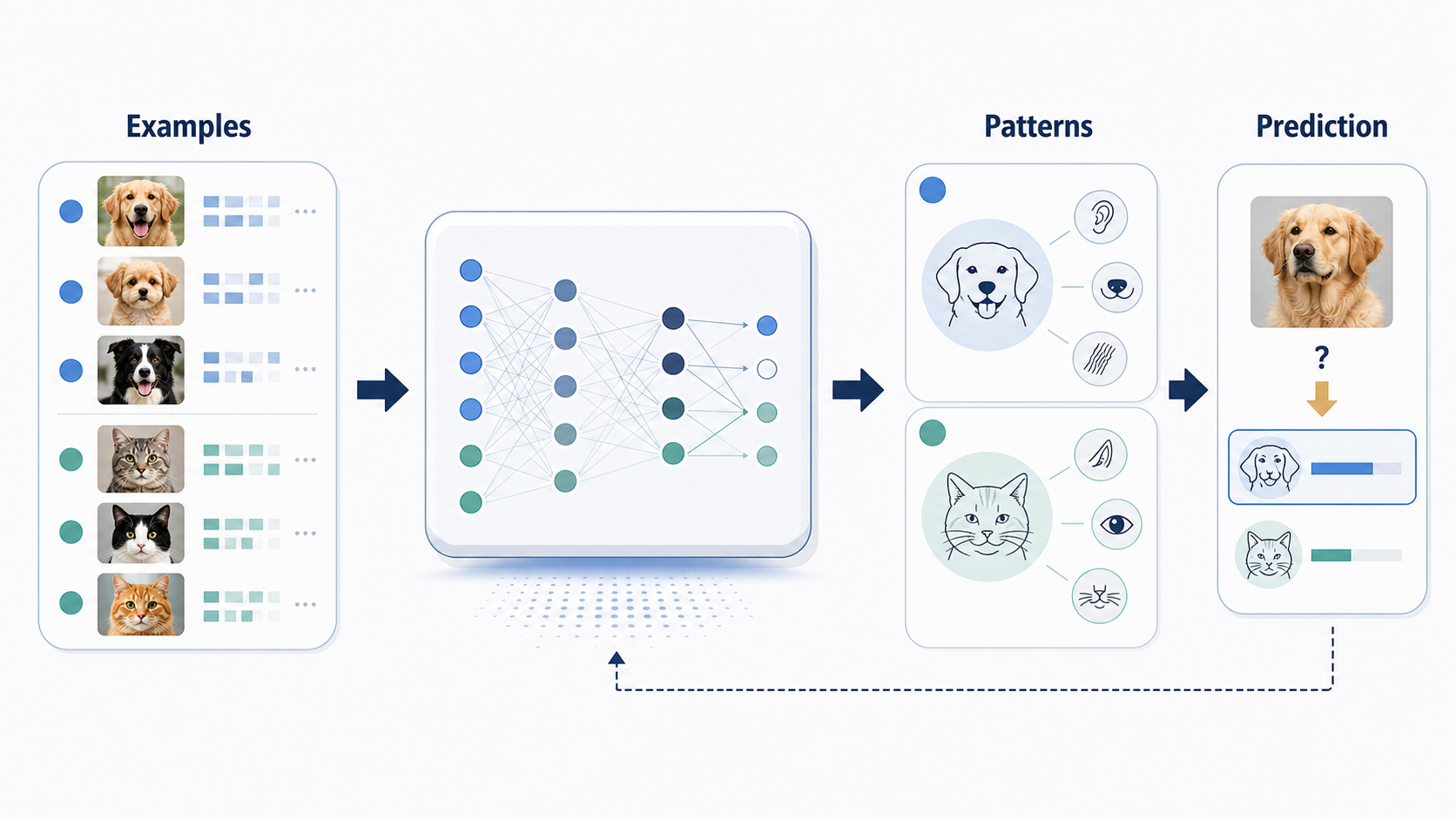
We often say "AI has learned." But AI learning is not the same as a human reading a textbook and understanding it. Let us explore how AI learns patterns from data and what sets it apart from human learning.
1. Humans Learn Meaning; AI Learns Patterns
Humans form meaning through experience. When a child learns the word "dog," they are not simply memorizing a sound. They see real dogs, touch them, hear them, and connect the concept across a variety of situations. That is why they can encounter a new breed of dog they have never seen before and still recognize it as a dog.
AI works differently. AI is given thousands or tens of thousands of dog images. Each image is represented inside the computer as numerical data. AI calculates the structures that appear repeatedly among those numbers. For example, it statistically analyzes specific outline shapes, the distribution of brightness at particular locations, and combinations of features that frequently appear together.
A human understands "this is a dog." AI calculates "when a pattern like this appears, the probability of it being a dog is high." AI does not understand concepts philosophically, but it develops a precise ability to distinguish patterns.
2. What Does AI Learn?
AI learning can be broadly divided into three types.
(1) Learning the Relationship Between Input and Answer
The most basic approach involves providing both input and a correct answer together. This is called supervised learning.
For example, the following data might be provided:
- A photo + the correct label "cat"
- An audio file + the text transcript "hello"
- Email content + "spam or not spam"
AI looks at the input and the answer simultaneously, learning which features are associated with which outcomes. In this process, the accuracy of the labeled data is critical. If incorrect labels are repeated, the learned result can become distorted.
(2) Discovering Structure Within Data
Learning can also occur without directly providing correct answers. For example, a music recommendation system analyzes behavioral records like "what did this person listen to after this song?" Even without a clear correct answer, the data contains recurring patterns of choices.
AI identifies these shared structures and learns a statistical tendency: "people with similar behavior tend to make similar choices." This approach focuses on discovering structure hidden within the data.
(3) Learning Through the Consequences of Actions
For cases where actions matter, such as game AI or autonomous driving systems, learning occurs through the results of those actions. When a specific action leads to a higher score, it is evaluated as a positive choice; a lower score means a negative choice.
For example, a Go AI that sees its win rate rise after a move reinforces that choice, and if the win rate falls, it revises that strategy. By repeating this process, it gradually forms strategies that achieve higher performance.
3. The Core of AI Learning: Reducing Error
The core of AI learning is the process of minimizing the difference between a prediction and the actual result, that is, reducing error. In the early stages, AI may get almost nothing right. But it calculates the gap between its predictions and the correct answers, then gradually adjusts its internal connection structure in the direction that reduces that gap.
For example, if AI correctly classifies only 30 out of 100 cat photos, it calculates the error from the incorrect predictions. It then adjusts internal weights (connection strengths) so that next time it gets 40 right, then 60, then 90. This process is repeated tens of thousands, even hundreds of thousands of times.
It is similar to how a person reviews a wrong answer with an explanation and corrects their understanding, but AI does this at an extremely high speed and on a massive scale of repetition. This iterative error-correction process is the fundamental principle of AI learning.
4. Why Is Data So Important?
AI does not generate common sense or background knowledge on its own. It can only make judgments within the scope of the data it has learned from. This is why what data was learned, how much, and in what way has a significant impact on performance.
For example, learning from hundreds of thousands of cat photos may improve the ability to distinguish cats. But if almost no dog photos were included, the ability to distinguish cats from dogs may be inaccurate. Similarly, if only daytime photos were used for training, accuracy may drop in nighttime or different lighting conditions. This is not because AI lacks understanding. It is because the situation falls outside the scope of the data it has experienced.
Particularly important factors in AI training include:
- Volume of data: A sufficient number of examples is needed to learn stable patterns.
- Diversity of data: A wide range of environments and conditions must be represented for the model to perform well in new situations.
- Accuracy of data: If many incorrect labels are present, the model's judgment criteria become distorted.
- Bias in data: If a particular group or situation is over- or under-represented, the results may be skewed.
In practice, there have been reported cases where facial recognition technology showed lower accuracy for certain racial or age groups. This was not a problem with the technology itself. It happened because the training data was skewed toward particular groups. AI's judgments ultimately reflect the characteristics of the training data.
5. Does AI Stop Learning Once It Has Been Trained?
AI is not a system that learns once and then stops. When new data becomes available, it can be retrained or the existing model can be updated to improve performance. This is essential for adapting to changing environments.
For example, a language model needs to reflect words and expressions that emerge over time. Terms like "metaverse" or "ChatGPT" did not exist in older data, but as they appeared in newer data, the model became capable of handling them.
In this way, AI does not store fixed knowledge; it is continuously updated based on data. Therefore, AI performance depends not only on the algorithm, but also heavily on how data is managed and refreshed.
6. What Is Similar and Different About How Humans and AI Learn?
Summarizing what we have covered, the comparison looks like this:
| Category | Humans | AI |
|---|---|---|
| Learning method | Forms meaning through experience | Calculates patterns from data |
| Speed | Slow but flexible and adaptable to context | Very fast but dependent on data |
| Scope | Can generalize from few examples | Requires a sufficiently large number of examples |
| Error handling | Corrects through intuition and reasoning | Corrects numerically by calculating error |
Humans can form concepts from just a few experiences and apply them to new situations. For example, even when encountering an unfamiliar animal, they can reason from existing knowledge. This is possible because of meaning comprehension and reasoning ability.
AI, on the other hand, requires sufficient data to perform reliably. But in certain domains, it demonstrates far greater computational speed and consistency than humans. Processing and analyzing thousands or tens of thousands of cases simultaneously is an area where AI excels in particular.
Humans and AI learn differently, but each has clear strengths. Humans are strong at understanding meaning and applying it flexibly; AI is strong at processing large-scale data rapidly and calculating precise patterns.