How Did AI Gain 'Intelligence'?
"The development of full artificial intelligence could spell the end of the human race, or it could be the best thing that ever happened to us." — Stephen Hawking
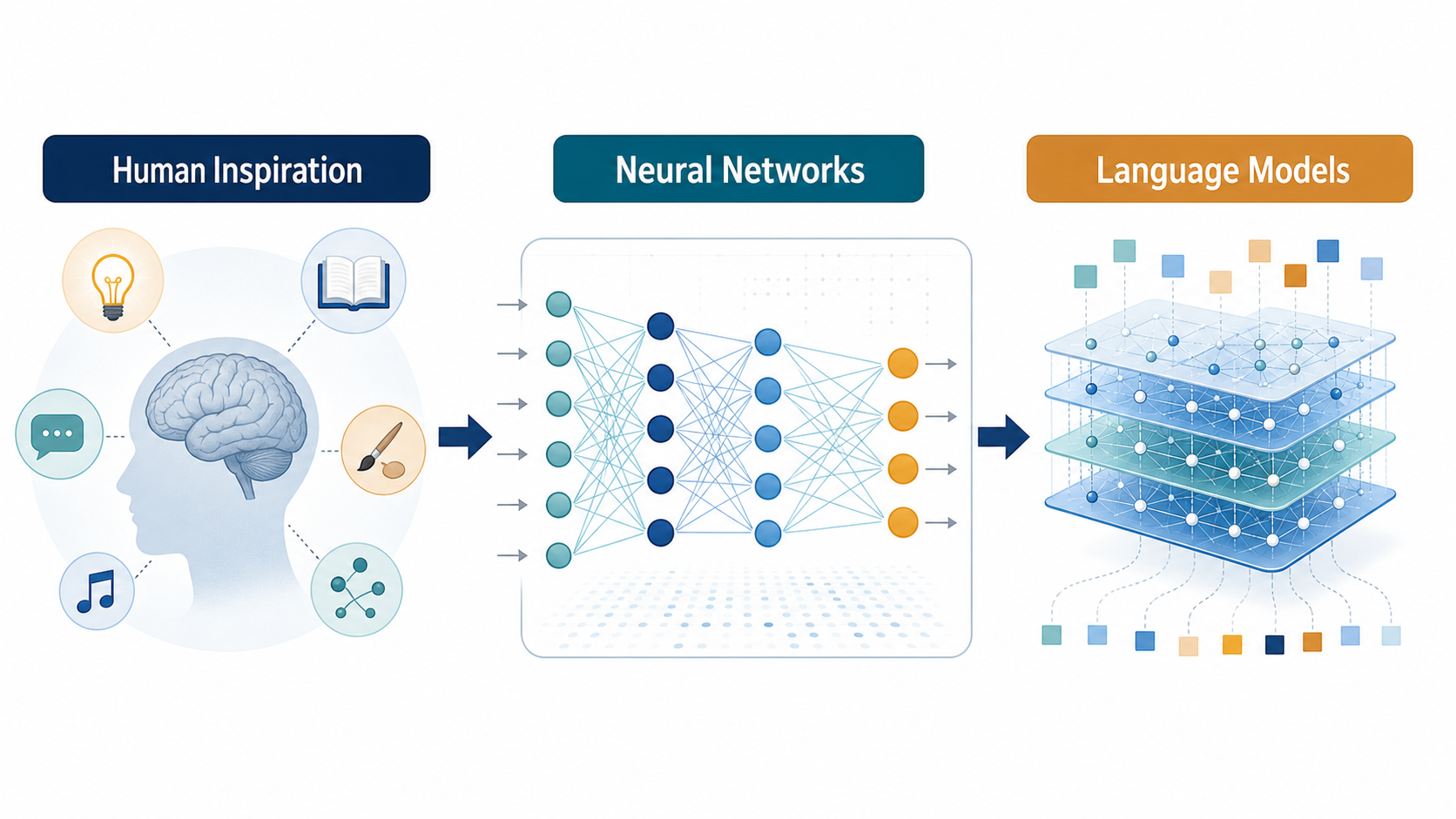
Why would Stephen Hawking, the theoretical physicist whose work on black holes and cosmology left a profound mark on modern physics, choose such a dramatic statement? He did not view AI as merely convenient software. Artificial intelligence is a technology that directly affects our intellectual capabilities, not our physical ones, a domain long considered uniquely human.
Past technological revolutions extended human strength and speed. The steam engine replaced muscle. Electricity transformed the nature of labor. Computers dramatically amplified our ability to calculate. But AI steps further into the realm of judgment, prediction, analysis, and creation, the territory of thought itself. This is fundamentally different from simple automation. It marks a shift from "machines that repeat fixed rules" to "systems that produce answers suited to context."
AI is already detecting subtle tumors that humans might miss in medical imaging, narrowing down drug candidates by analyzing tens of millions of chemical combinations, and solving protein structure prediction, a long-standing scientific challenge. It has defeated the world's top professional Go players and reached a level of writing that is hard to distinguish from human-authored text. More recently, it has moved beyond text to understand and generate images and audio, rapidly handling real-world tasks like document summarization, meeting transcription, and code writing.
At the same time, concerns are real. Deepfake technology shakes our trust in information, AI-generated content floods social media, and AI-driven decision-making risks reinforcing social inequalities when trained on biased data. When Hawking warned of "the best or the worst," he was not making a moral judgment about the technology itself. He was warning about what happens when it surpasses the range of human understanding and control.
In an age where everyone is talking about AI, humans must understand it to use it well and coexist with it.
So how does AI actually work? It appears to converse, write, and solve problems, but what calculations and learning processes are happening inside?
How Does AI Appear to "Think"?
When we ask AI a question and receive a plausible answer, we naturally feel like it "understood." It seems to grasp context, develop logic, and sometimes even express empathy. But there is a fundamental difference between how humans think and how AI "thinks."
Human thought is meaning-centered. When we hear words, we recall their meanings, infer the speaker's intent and context, and bring our own experiences and emotions to bear on our judgments. Understanding is not merely stringing sentences together; it involves considering context, values, and purpose.
AI works differently. Rather than grasping "meaning," AI processes input based on patterns repeatedly observed in data. When presented with the sentence "today's weather feels gloomy," a human might picture overcast skies or a low mood. AI, by contrast, calculates which words tend to appear alongside "gloomy" and what sentence is most likely to follow. It does not feel emotion; it predicts the statistically most plausible next expression.
Put simply: humans interpret meaning; AI predicts patterns. So even when AI produces a remarkably natural response, that does not mean it understands things the way humans do or has consciousness. AI is simply a system that learns recurring patterns from human language and behavior, and produces the most plausible output whenever those patterns appear.
Still, this should not be underestimated. Pattern prediction alone can generate results that are natural and convincing. AI systems like ChatGPT and Gemini, trained on massive datasets, already produce results comparable to those of humans, and sometimes more refined.
The reason AI appears to "think" is that many tasks we consider products of thought are actually deeply intertwined with sophisticated pattern recognition and reconstruction.
So How Is AI Built?
AI did not begin as a technology for handling language. It started with a much simpler question: Can the way the human brain learns be implemented mathematically?
The human brain contains roughly 86 billion neurons, connected in networks that send and receive signals. Critically, these connections are not fixed. With experience, some connections strengthen while others weaken. When learning to ride a bike for the first time, balance is hard to maintain, but after repeated practice, the body holds it effortlessly, almost without thinking. This mastery involves gradual adjustments in the strength of connections between neurons in the brain.
Researchers simplified this principle into a computational structure. Multiple inputs are received, each multiplied by a weight that reflects its importance, and the values are summed and passed to the next stage. AI learning is ultimately a process of gradually adjusting these weights, and the predictive structure formed through this learning is called an artificial neural network (ANN). An artificial neural network is incomparably simpler than an actual brain, but it is a mathematical model that implements the core idea of "learning by adjusting connection strengths."
But complex processes like human thought are hard to approximate with a single computation. So AI researchers began stacking these probabilistic neural networks into multiple layers. Earlier layers capture simple features; subsequent layers combine these into more complex features; and the final layer makes the ultimate judgment. This deeply stacked structure is called deep learning.
In image recognition, for example, the first layer detects basic patterns like edges and brightness changes; the next layers combine these to recognize more complex shapes like eyes, noses, and ears; and the final layer decides whether the image is a "cat." The key point is that AI does not recognize a cat because it "understands" cats. It learns the statistical patterns in the combinations of features that repeatedly appear across vast numbers of cat images, and makes probabilistic judgments.
What Does It Mean for AI to Learn?
Simply put, AI learning is a process of correcting itself to the extent it is wrong. AI does not start out knowing the answers. Instead, it calculates "how far its current prediction is from the correct answer" and adjusts the connection values between neurons in the direction that reduces that error.
Take the cat photo example again. AI sees a photo and predicts "20% probability it's a cat." If the correct answer is cat, the error is large. So AI adjusts its internal connection values to make the probability of "cat" higher next time. Repeating this process hundreds of thousands, even millions of times makes the predictions increasingly accurate.
The crucial point is that humans do not directly input the rules. In older approaches, people had to design rules like "if the ears are pointed, it's more likely a cat." Deep learning finds these rules on its own, from the data. That is why performance improves substantially with more data and sufficient computational resources.
This principle applies not just to images but equally to speech recognition. Hearing "hello" countless times and repeatedly learning which sounds correspond to which characters makes it possible to convert speech to text. Translation works the same way: learning vast numbers of paired sentences and how expressions frequently correspond to one another enables natural translation.
Deep learning-based AI models are not beings that understand through mental processes the way humans do. They are systems that precisely capture recurring structures in data. And when this system develops sufficiently, it produces results that, to our eyes, appear as though it is "thinking."