How AI Generates Responses Probabilistically
As we saw in the section on inference, the core of AI inference is using already-learned weight matrices to calculate the next state for a new input.
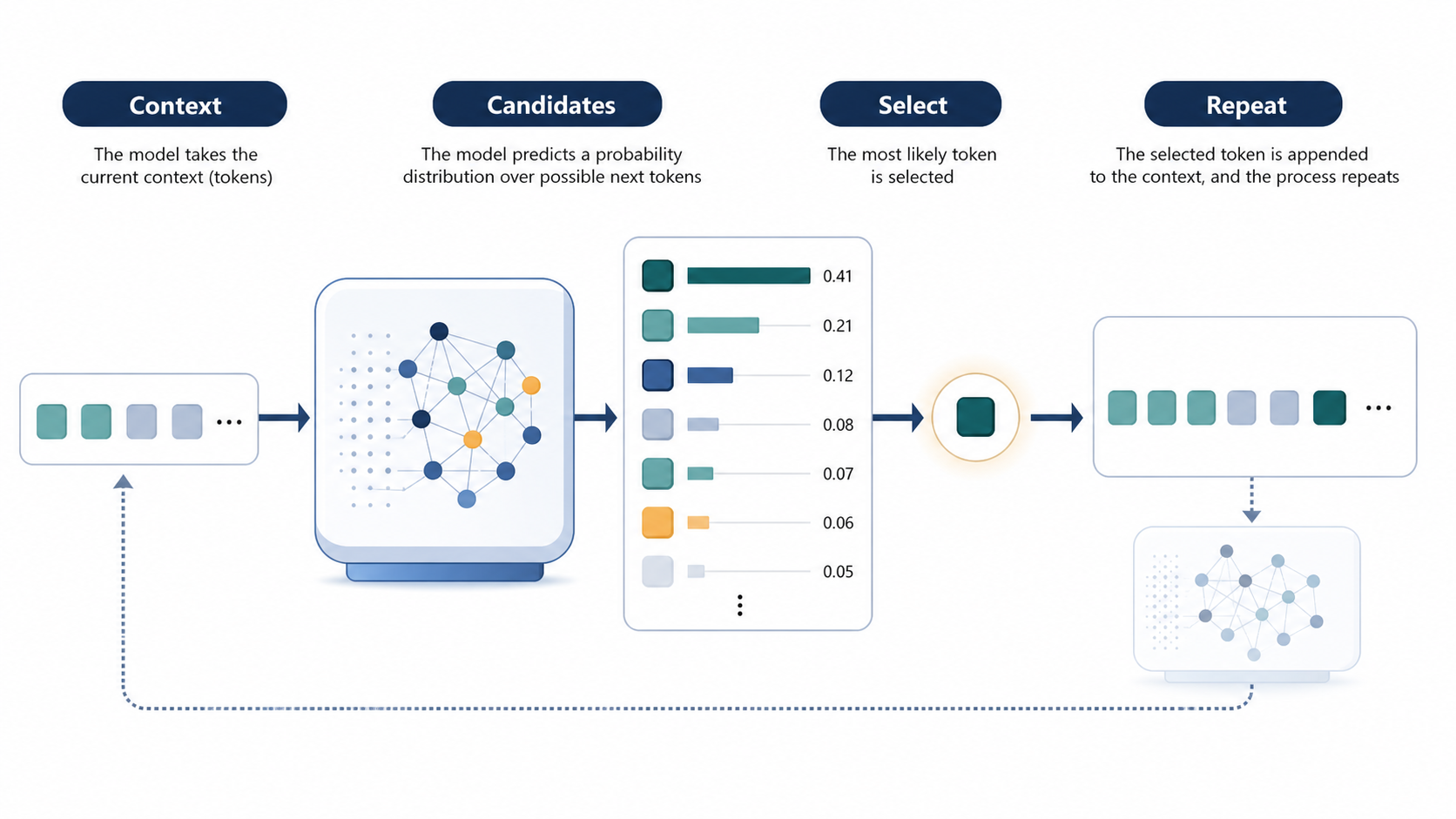
Text generation through inference is also not a matter of producing an entire response sentence at once. Based on what has already been generated, the model probabilistically calculates and selects the next token, then repeats this process. As this repetition continues, a complete sentence takes shape.
How Is a Sentence Built?
For example, suppose a user asks the following question:
Explain AI simply for a high school student.
The model splits this sentence into tokens and converts each token into a numerical vector. It then calculates the probability of "the next token" based on the entire input so far.
For example, at the first position the following candidates might be calculated:
| Candidate Token | Probability (example) |
|---|---|
| AI is | 0.35 |
| Artificial intelligence is | 0.28 |
| Simply put | 0.15 |
| First | 0.07 |
| Other | ... |
If the token with the highest probability is selected, the sentence begins:
AI is
Now the model calculates again. It recalculates the probabilities of candidate tokens that could follow "AI is" and selects one. This process repeats as the sentence gradually grows longer.
The key point is that the model does not complete the full sentence in advance. It calculates the next token fresh at every step.
How Is This Kind of Generation Possible?
During training, the model repeatedly processed a vast quantity of sentences. Through that process, statistical patterns about which expressions tend to follow which other expressions, and which structures feel natural, are reflected in the internal weights.
For example, if many sentences like these appeared in training:
- "AI is … a technology."
- "AI is … a system."
- "AI is … a model."
These patterns are incorporated into the internal probability structure. So when the beginning "AI is" appears, it is calculated as highly likely that an explanatory sentence will follow.
The key here is that the model is not selecting based on understanding the meaning itself. It calculates and selects the flow with the highest probability in the current context, based on patterns formed from the training data.
A Sentence Is Not Determined From Start to Finish in Advance
AI does not finalize the full structure of a response before it begins. Only after the first token is selected is the second token determined, and only after the second is the third calculated.
As a result, the early selections can significantly alter the direction of what follows.
For example, for the same question:
- Starting with "AI is technology that mimics human thinking" is likely to lead into an explanation-centered structure.
- Starting with "If I were to define AI in one sentence…" is more likely to lead into a definition-centered development.
The first few token choices determine the direction of the entire response.
Why AI Sometimes Produces Unusual Responses
Understanding this generative structure explains a few phenomena.
First, plausible but incorrect information can be generated. The model is not checking facts from an external source. It is selecting "the most natural next sentence given the current context." This is why a paper title or date that does not actually exist can be fabricated.
Second, expressions can become repetitive. Safe, high-probability expressions are selected frequently. As a result, sentence structure and phrasing can start to resemble one another.
Third, earlier and later parts of a long response can become inconsistent. As sentences grow longer, the effect of earlier selections accumulates, and once the structure starts to drift, generation continues from that drifted state.
How the Selection Method Affects the Response
The model can be configured to always select only the highest-probability candidate, or to select from among multiple candidates within a certain range.
- Selecting only the highest probability produces stable but potentially monotonous responses.
- Allowing selection from among the top probability candidates produces more varied responses, but increases the chance of the answer changing.
In creative work, variety is an advantage; in tasks where precision matters, stability is more important.